FitBook didn't start as a studio platform. It started with my wife's alarm clock. And mine. Every single night.
The Midnight Ritual
For six months, my wife woke up at midnight to book her Pilates classes. Not once a week—every single night.
Her studio's booking window opened exactly 9 days before each class. Want to book Monday's 6am Pilates? You need to be on the app at midnight the previous Saturday. Tuesday's class? Midnight Sunday. And so on.
Every. Single. Night.
She'd set her alarm for 11:59pm, wake up, and race against hundreds of other members to tap her phone at exactly 12:00:00. If you were even a few seconds late, the popular classes were gone. Then she'd wake me up—"Did I get it? Check if the confirmation came through"—and we'd both go back to sleep.
We have two young kids. Sleep is already a precious commodity. Adding a nightly midnight alarm on top of that? It was absurd.
And once a month, it got even worse.
When her membership auto-renewed, the system wouldn't process it until around 12:20 or 12:25am. So on those nights, she'd wake up at midnight, try to book, and get rejected—"membership inactive." By the time it finally renewed, every class was already full.
She was a paying member on the studio's most expensive tier. She'd been loyal for months. And once a month, the system punished her for it.
The studio owner's response? Nothing. For months. Eventually, after repeated complaints, she agreed to manually book my wife into classes on renewal nights.
So much for "fair."
I'm a software engineer. After watching this for months, I decided to do something about it.
"I'll Just Build Something"
So I did. I built a simple tool that monitored class schedules and booked automatically the moment registration opened. No alarms. No midnight wake-ups. Just confirmed bookings waiting in her inbox every morning.
It worked perfectly.
For the first time in six months, we slept through the night (well, as much as two young kids allow).
Word Spread
My wife works in sales. She mentioned it to a few friends at the studio. They wanted in. Then their friends wanted in. Then their friends.
The feedback was immediate and overwhelming:
"This changed my life."
"I haven't set a midnight alarm in months."
"I actually get into the classes I want now."
We weren't solving a minor inconvenience. For people who were serious about their fitness routines, this was solving one of their biggest daily frustrations.
Then Things Got Complicated
Everything was going great—until it wasn't.
Not everyone at the studio was happy. Some members thought automated booking wasn't "fair." They complained to the studio owner. Why should some people get to sleep while others are still setting midnight alarms?
The studio owner wasn't thrilled either. They went to their booking platform trying to figure out how to block our users. They tried everything they could think of.
They couldn't.
The 8pm "Fix"
At the end of December 2025, the studio finally opened a second location. With it, they changed the booking window from midnight to 8pm.
Members had asked for this for months. The studio owner couldn't be bothered—until now.
No more midnight alarms. Problem solved, right?
Not quite. Now that bookings opened at a reasonable hour, more people could compete. The most popular classes—and their entire waitlists—started filling up in under two minutes.
The problem was never the time. The problem was the race itself.
The Threat
A couple weeks later, on January 8th, 2026, the studio sent out a threatening email to their members. Use automation? You'll be removed from the studio. Your membership will be revoked.
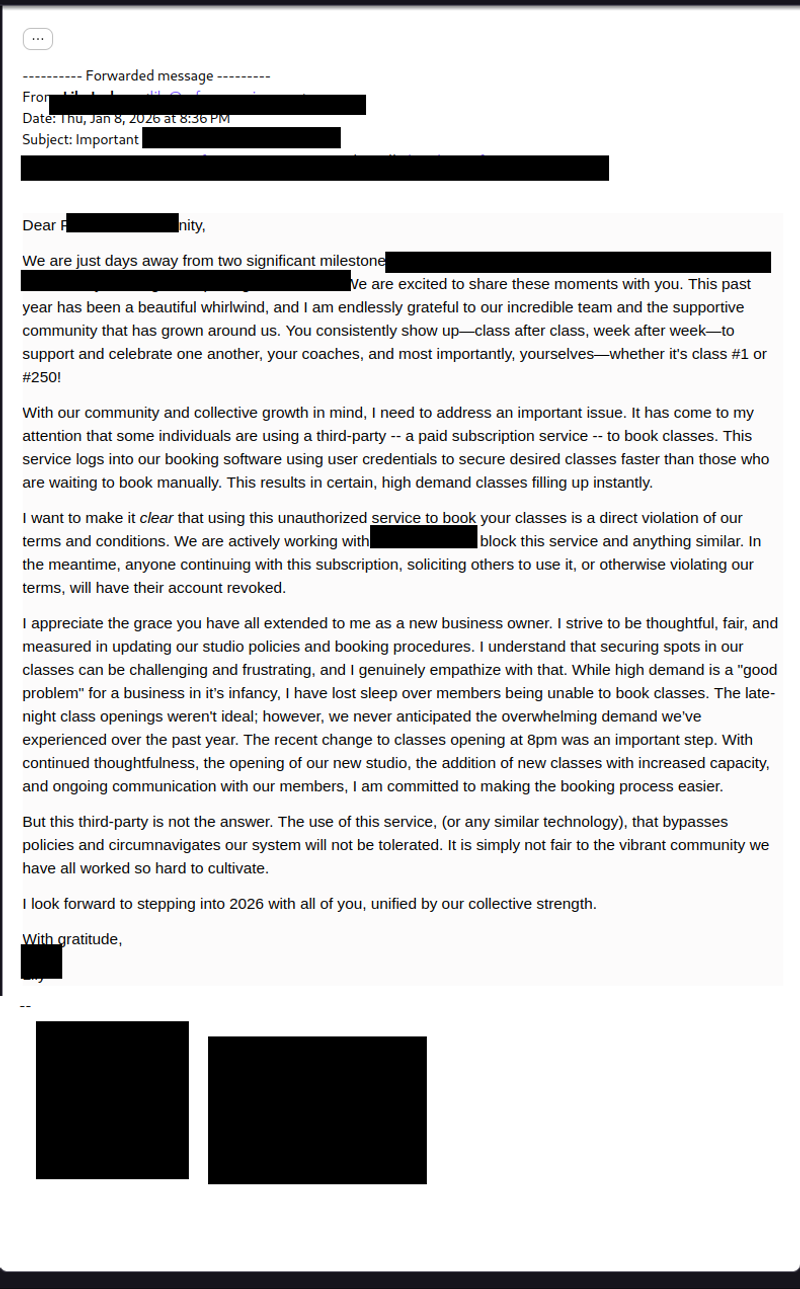
(If you read closely, you'll notice the email talks about "stepping into 2026"—at least some of it was drafted before the new year, then sat through the holidays before finally being sent.)
Our users—people who loved this studio, who had been loyal members for years—were suddenly being threatened because they wanted a good night's sleep.
Studios had all the power. Members had none.
The Breaking Point
We had a choice: shut down and walk away, or build something bigger.
The legacy booking platforms weren't going to help. They were built for studios, not members. As far as they were concerned, members racing to book was a feature, not a bug. It created "engagement." It drove "urgency."
It drove exhaustion, frustration, and resentment.
That threatening email was meant to shut us down.
Instead, it lit a fire.
They thought they were ending something. They were starting something.
Building for Both Sides
But we didn't want to just build another booking tool for consumers. We wanted to build a platform that worked for everyone—studios AND their members.
What if we built a modern platform from scratch? One where:
- Studios get powerful tools to run their business—and control over how automation works
- Members get a booking experience that actually respects their time
- Everyone benefits from modern technology instead of fighting against decade-old software
That's FitBook.
The Platform We Wished Existed
We built the platform we wished existed from the start.
For studios:
- Modern, real-time software that doesn't feel like it's from 2010
- Simple pricing without per-booking fees eating into your revenue
- SmartBook—automated booking that you control, not your members
For members:
- SmartBook automation so they never have to race for spots again
- A beautiful booking experience that works on any device
- Studios that embrace technology instead of fighting against it
Why This Matters
The fitness industry has been stuck with legacy software for too long. Studios deserve better tools. Members deserve better experiences. And nobody deserves to set a midnight alarm just to book a workout class.
We're not trying to be the biggest platform. We're trying to be the best one—for everyone who uses it.
That journey started with a midnight alarm (and a cranky, sleep-deprived software engineer). It continues with every studio that joins us and every member who never has to set that alarm again.
Ready to join us? Start your free trial.